Key takeaways
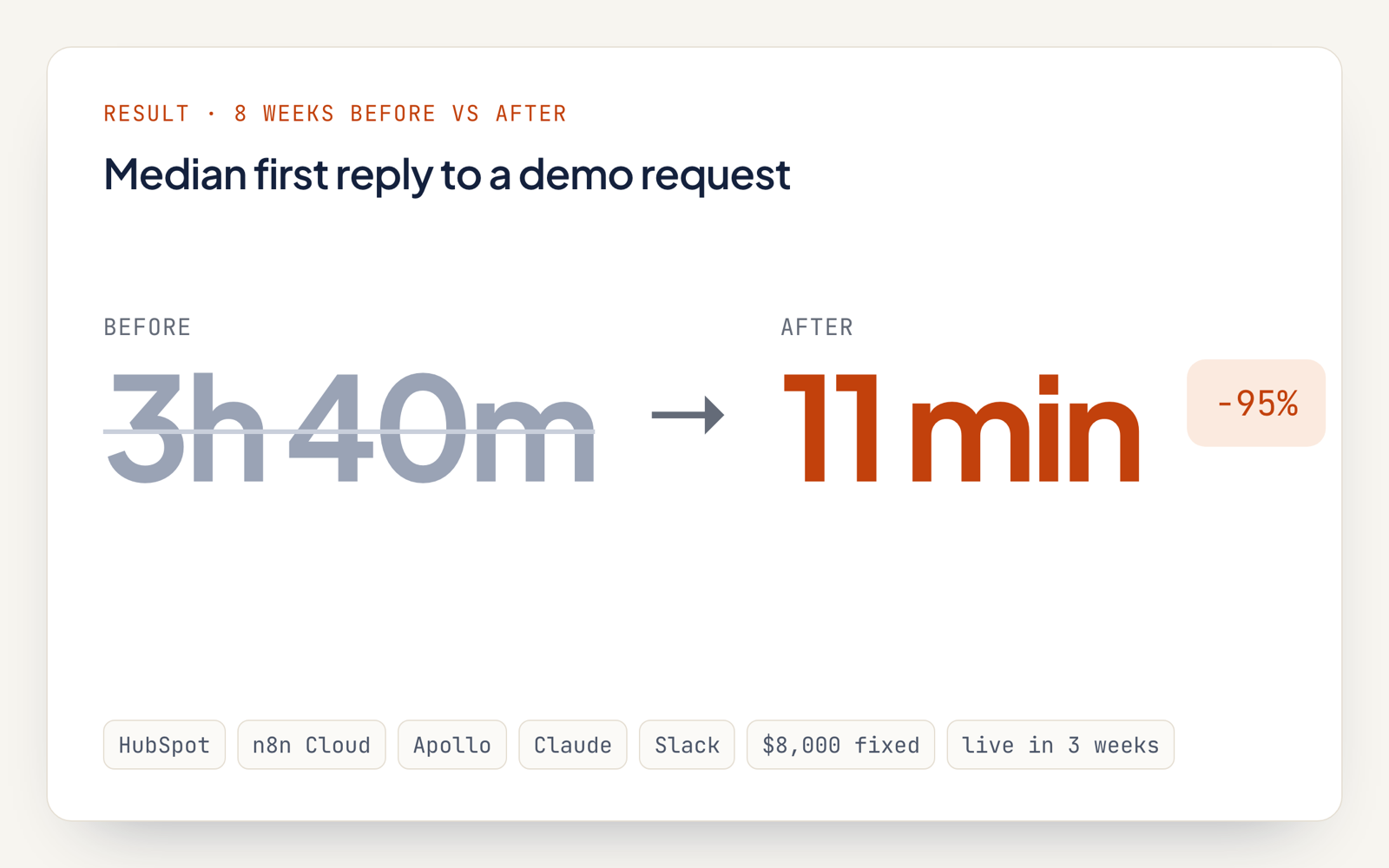
- Comparing the 8 weeks before and after go-live, the company's median time to first reply on demo requests dropped from 3 h 40 min to 11 min.
- Once routing combined rules with a Claude fit score, the share of leads reassigned to a different owner fell from 9% to 1.5%.
- Claude only drafts each reply and scores the lead; reps send every message themselves.
- Pricing came in at a fixed $8,000: $1,500 for the audit and $6,500 for the workflow build.
What problem did the sales team have?
The sales team handled demo requests by hand, so the median first reply took 3 hours 40 minutes.
- Volume: one HubSpot form brought in about 40 demo requests a week.
- Manual triage: each request went to the sales lead, who looked up the company, weighed fit and picked the owner in HubSpot.
- Misrouting: 9% of leads landed with the wrong territory owner and needed reassignment.
- Equal effort: poor-fit requests ate the same rep time as strong ones.
How does the HubSpot lead routing workflow work?
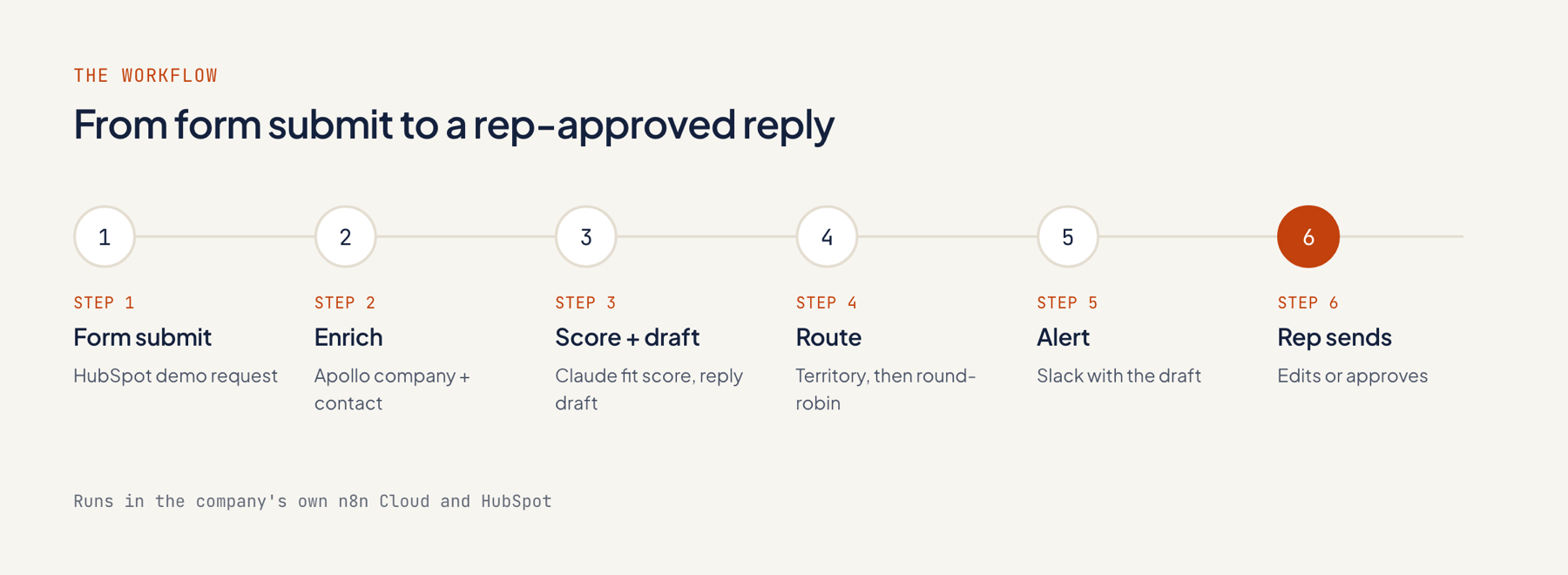
The HubSpot workflow Applied Agents set up is one n8n automation: within 2 minutes of a form fill, it enriches the demo request, scores it, routes it as a HubSpot deal and leaves a reply draft for the owner.
- Trigger: everything starts when someone submits a HubSpot form.
- Dedupe: the workflow searches HubSpot for a matching contact, company or open deal and links the new request to that record.
- Enrich: Apollo fills in headcount, industry, country and job title.
- Score: Claude rates the lead from 1 to 100 against the written ideal customer profile (ICP) and stores three reasons on the deal.
- Route: territory and segment determine the sales pod, and round-robin assigns the rep inside it. Anything under 40 lands in a nurture sequence, while scores of 40 to 60 go to the sales lead.
- Draft: Claude composes the first reply using the prospect's own words and files it as a task on the deal.
- Alert: the owner receives a Slack message with the score, reasons, summary and draft, then edits and sends straight from HubSpot.
One workflow, two AI steps: that is the whole shape of a standard AI sales automation build.
Which tools does the workflow use?
The workflow uses five tools, all of them in the client's own accounts: HubSpot, n8n Cloud, Apollo, Claude and Slack.
| Layer | Tool | Job |
|---|---|---|
| CRM | HubSpot | Form, contacts, companies, deals, owners |
| Workflow | n8n Cloud | Runs every step and logs each run |
| Enrichment | Apollo | Company and contact data |
| AI | Claude, through the Anthropic API | Fit score, reasons, reply draft |
| Alerts | Slack | Owner notification with the draft |
Fixed rules cover five of the seven steps. Claude comes in only where a step calls for judgment: reading a free-text request against the ICP and writing a reply.
What stayed with people?
People kept control of every prospect-facing step. Reps send each reply, run each call and can override any score; the workflow never contacts a prospect alone.
- Inside HubSpot, the owning rep edits and sends each AI draft.
- Leads scoring 40 to 60 go to the sales lead for a decision.
- A rep can adjust the score or owner on any deal; every adjustment is logged for the quarterly ICP review.
- The written ICP Claude scores against belongs to the VP of Sales.
What changed, and how was it measured?
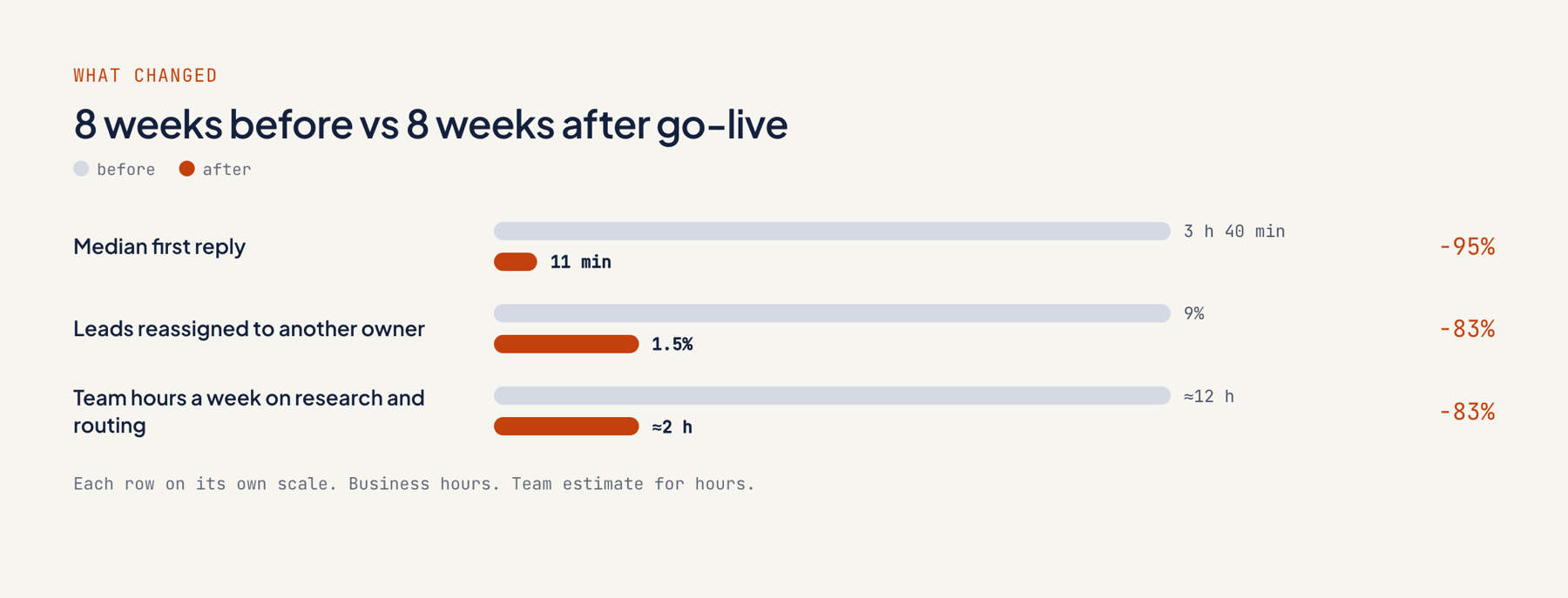
Median first reply time dropped from 3 h 40 min to 11 min, measured during business hours in HubSpot across the 8 weeks following go-live versus the 8 weeks before it.
| Metric | 8 weeks before | 8 weeks after |
|---|---|---|
| Median time to first reply (business hours) | 3 h 40 min | 11 min |
| Leads reassigned to a different owner | 9% | 1.5% |
| Hours a week on lead research and routing (team estimate) | About 12 | About 2 |
| Demo requests handled | 318 | 334 |
Claude's score band agreed with the sales lead's own rating on 87 of 100 leads reviewed in a blind check. All figures come from the client's first-party data.
What did the project cost, and how long did it take?
Total cost came to $8,000, in two fixed fees: $1,500 for the one-week audit, $6,500 for the workflow build.
| Stage | Time | Price |
|---|---|---|
| Scoping call | 30 minutes | Before the audit |
| Audit and fixed quote | Week 1 | $1,500 |
| Build and testing on real leads | Weeks 2 and 3 | $6,500 |
| Hand-over with documentation | End of week 3 | Included |
n8n, Apollo and Claude spend runs on the client's own accounts and is billed there. See the pricing and how it works pages.
What can other B2B sales teams take from this?
The main takeaway: AI handles only two of the seven steps in this workflow, so the other five stay testable and trustworthy like any plain rule.
- Document the ICP before you automate. Claude scores leads only against criteria a person has written down.
- Hand borderline scores to a human. The 40 to 60 band catches edge cases and keeps them off automatic paths.
- Deliver the draft where reps already work. A Slack alert with the draft attached means nobody starts from a blank page.
- Record a baseline period. Eight weeks of HubSpot baseline made the result straightforward to verify.
To scope a similar build for your team, book a scoping call.
FAQ
How long did the build take?
Three weeks from kickoff: one week for the audit, then two weeks of building and testing on real leads.
Does the AI email prospects on its own?
No. Claude drafts the first reply; the owning rep edits it and sends it from HubSpot.
Why n8n instead of Zapier?
n8n fits because each lead moves through branching routing rules and two AI steps; Zapier covers simpler, lower-volume flows.
Should leads be assigned round-robin or by territory?
Both. Territory and segment pick the pod that owns the lead; round-robin then splits leads evenly among that pod's reps.
Who owns the workflow after hand-over?
The client owns it. The workflow runs in the client's own n8n account, and the hand-over includes written documentation.