
Key takeaways
- An AI agent is software that lets an AI model choose the next step and take action inside your tools, like the CRM or helpdesk, within boundaries you define.
- Applied Agents delivers a single-purpose agent from $12,000, live in 4–6 weeks, measured against a baseline you agree before work starts.
- When unsure, an agent routes the task to a person, and humans approve AI-drafted replies.
What is an AI agent for business?
An AI agent for business is software built on a large language model that picks each next step and acts in your tools, like updating a CRM record or drafting a ticket reply, until the task is done.
- Chatbot: gives one answer, then quits.
- Workflow automation: runs on fixed rules, like "new form fill, create deal".
- AI agent: reads messy input, chooses what to do next, works in your tools and passes the task to a person when unsure.
Most business processes need all three, and the agent handles only the steps that call for judgment.
What can AI agents do for a business?
Agents handle the business tasks that combine free-text input with a decision to make: in B2B teams, that is sales, support and document work.
- AI sales agent (AI SDR): digs into an account, scores its fit against your ICP, writes the first-touch and follow-up emails, and schedules the meeting after a rep signs off.
- AI support agent: answers routine questions out of your help docs, tags and routes everything else, and passes the ticket to a person with a summary when it is unsure.
- Document agent: reads contracts or invoices across varied layouts and flags anything that strays from your standard terms.
- Ops agent: drafts the reminders for unpaid invoices and builds the weekly pipeline report.
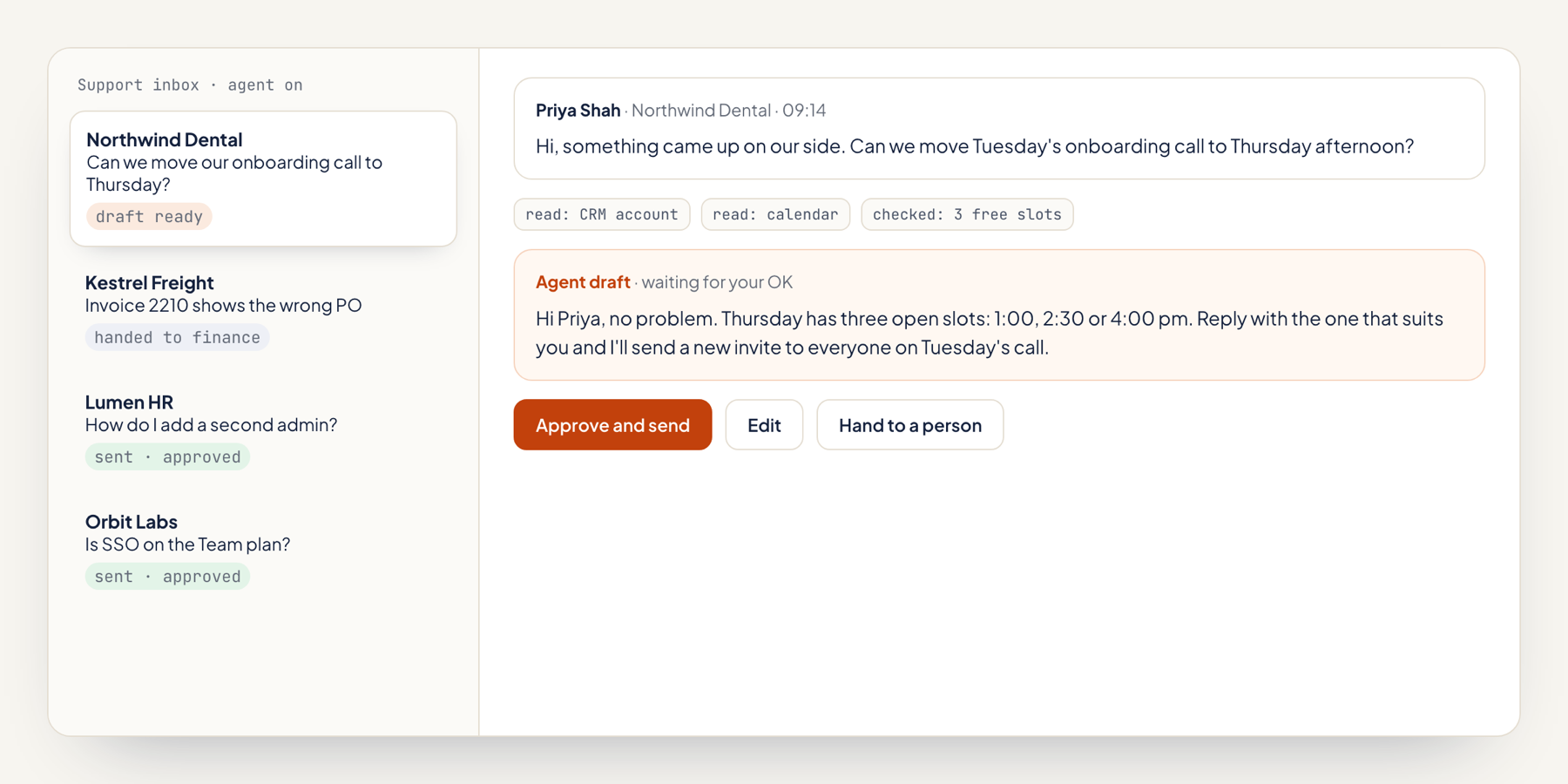
One support case: a customer asks to switch a renewal to annual billing, and the agent prepares the change for the account manager to approve.
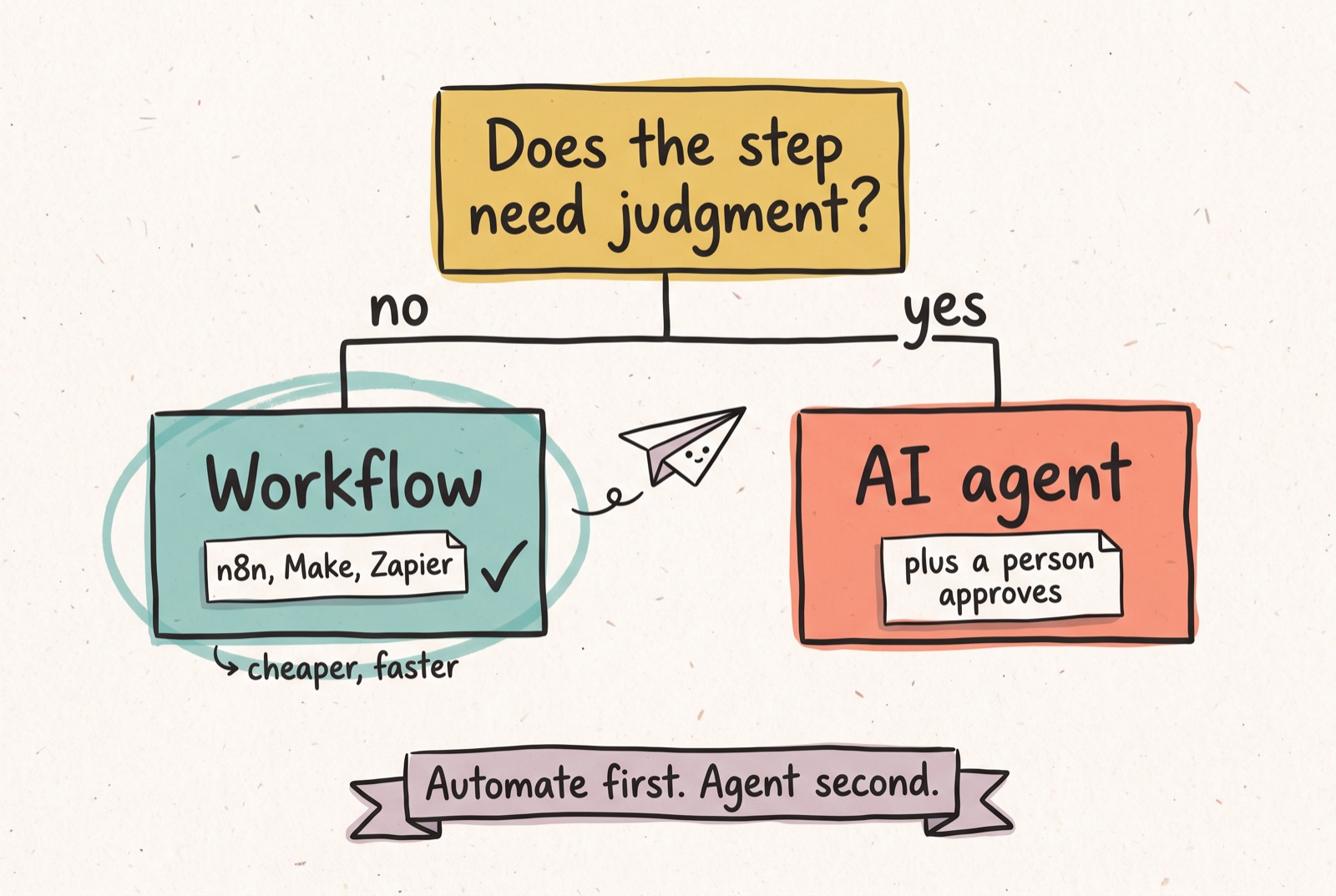
Does your team need an AI agent or a simpler workflow?
An agent makes sense only for the step that needs judgment; everything else belongs in a cheaper, predictable workflow.
- Stick with a workflow when inputs are structured and the rule stays fixed, as with routing leads by territory. Builds start at $5,000; see AI sales automation.
- Go with an agent when requests arrive as free text, the right call changes case by case, or the job touches several tools.
- Keep it in-house if your engineers have time and the agent powers your core product.
- Bring us in if you run a B2B team of 10–200 and the agent handles sales or operations work.
How much does AI agent development cost?
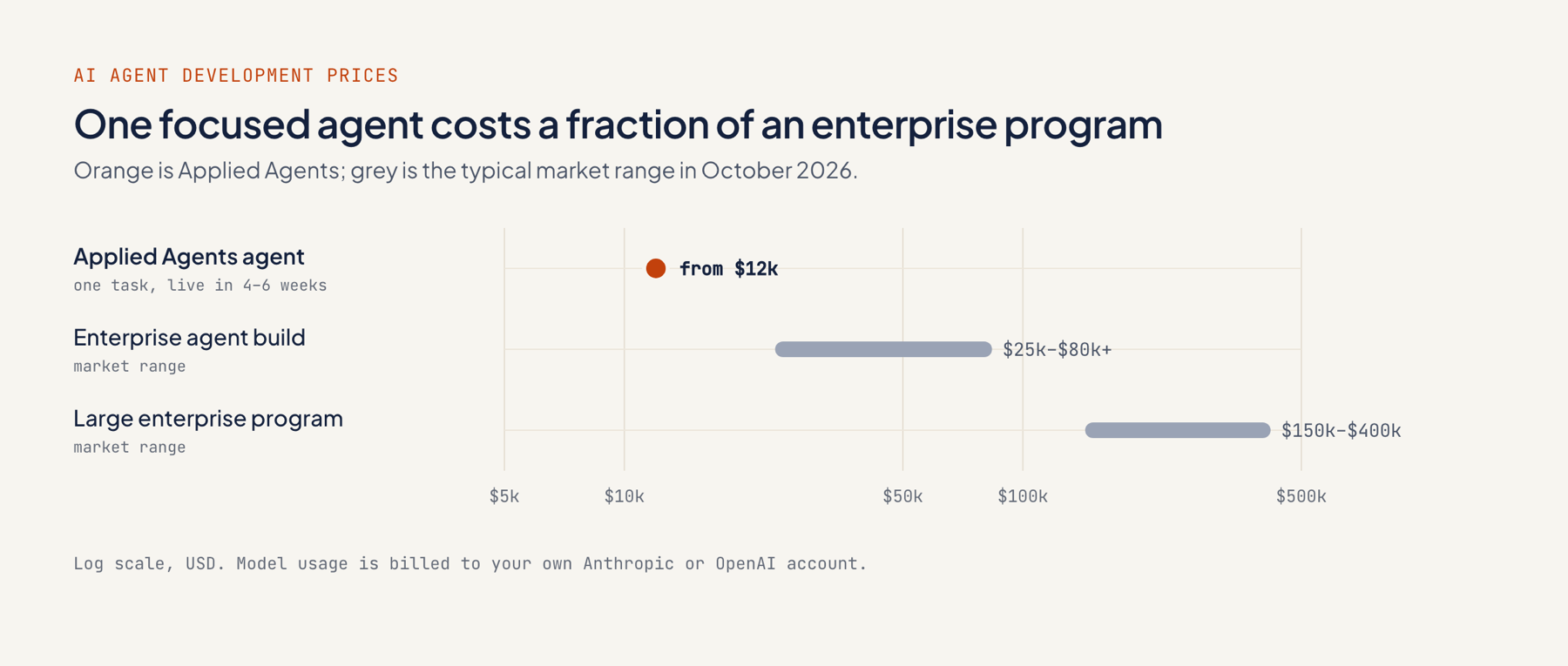
A single-purpose agent from Applied Agents starts at $12,000 fixed. Enterprise agent builds usually cost $25,000–$80,000+.
| Item | Applied Agents | Typical market range |
|---|---|---|
| Audit and fixed quote | $1,500, 1 week | Usually part of a paid discovery phase |
| One AI agent | From $12,000, live in 4–6 weeks | $25,000–$80,000+ (enterprise, Sept 2026) |
| Large enterprise program | Not offered | $150,000–$400,000 |
| Running and improving it | $2,500/month, cancel any month | $1,500–$8,000/month |
| Hourly developers | Not offered | $100–$300/hour |
Anthropic or OpenAI bills model usage to your own account. Our pricing page has details.
How does an AI agent build work?
Budget 4–6 weeks for an agent build once the audit is done; it goes live with a person approving its actions.
- Day 1 scoping call: 30 minutes to choose the one task you want to hand over.
- Week 1 audit and baseline: we record how the task performs right now, think hours per week or time to first reply, and quote a fixed price.
- Platform test: the same task runs on Claude, OpenAI or OpenClaw, and we keep whichever performs better on your data.
- Build: we connect your tools through a custom MCP server, so the agent can only touch what you permit.
- Approved launch: your team signs off on drafts and hand-offs from day one.
- Measure and hand over: we compare results against the baseline and leave you the documentation.
All of this follows our standard four-step process.
What's included in an AI agent build?
You get one working agent, wired into your tools, with an approval flow and the data to judge it.
- Your agent runs on Claude, OpenAI or OpenClaw, inside your own accounts.
- Integrations with your CRM, helpdesk, inbox or documents, with permissions and logs included.
- Human approval built in, plus a hand-off rule whenever the agent is unsure.
- Before-and-after results measured against your baseline.
- Full documentation plus a hand-over session for the people who will supervise it.
Claude, OpenAI or OpenClaw: which agent platform fits?
The task decides the platform: we build on all three and test before committing to one per task.
| Platform | What we use | Fits |
|---|---|---|
| Claude (Anthropic) | Claude Agent SDK and managed agents | Multi-step work across your tools; see Claude agents |
| OpenAI | OpenAI Agents SDK and Responses API | Agents inside your own apps or in ChatGPT |
| OpenClaw | Self-hosted open-source agent | Teams that want an agent in Slack or WhatsApp on their own server; see OpenClaw setup |
| No-code builders (Zapier Agents, Lindy, Relevance AI) | We don't build on these | Simple personal or team assistants you configure yourself |
| Suite agents (Microsoft Copilot Studio, Salesforce Agentforce) | We don't build on these | Companies standardized on that vendor's suite |
If you came for OpenAI consulting: we build OpenAI agents with the Agents SDK, and we have no OpenAI partnership.
How does Applied Agents compare with other AI agent development companies?
Applied Agents ships one agent at a fixed price for a 10–200 person team, while enterprise firms scope whole programs, freelancers charge hourly and DIY builders demand your hours.
| Applied Agents | Freelancer | Enterprise firm | DIY agent builder | |
|---|---|---|---|---|
| Fits | One sales, support or document agent for a 10–200 person team | A prototype | Enterprise programs (Accenture, Deloitte, LeewayHertz) | A simple assistant for one person or team |
| Price | From $12,000 fixed | $100–$300/hour | $25,000–$80,000+; up to $150,000–$400,000 | Subscription plus staff time |
| Human approval | Built in | Varies | Usually included | You configure it |
| Measured result | Against an agreed baseline | Rarely | Program-level KPIs | Up to you |
What are the risks of AI agents, and how does human approval work?
Agents can go wrong on inputs they haven't seen before, so we restrict what each one can reach and put a person between the agent and your customers.
- Permissions: a custom MCP server exposes only the actions you approve, like reading deals and creating notes, with deletes excluded.
- Approval: drafted emails and replies sit in a queue until a person signs off.
- Hand-off: when confidence drops, the agent passes the case to a person with a summary attached.
- Running cost: each agent run consumes paid model calls, and we estimate that spend during the audit.
- Scope: consumer chatbots and custom machine-learning models fall outside what we build.

Which projects show this in action?
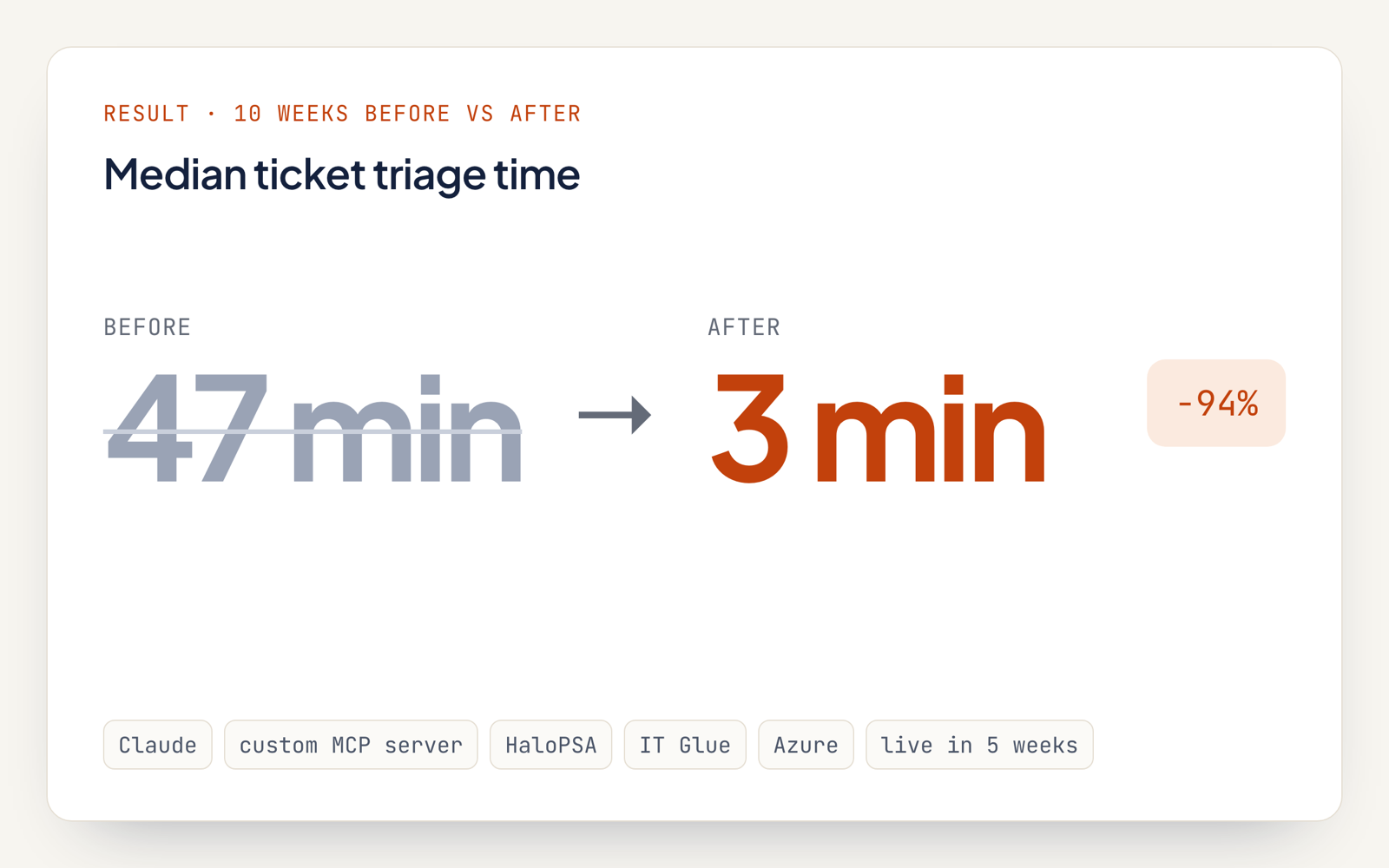
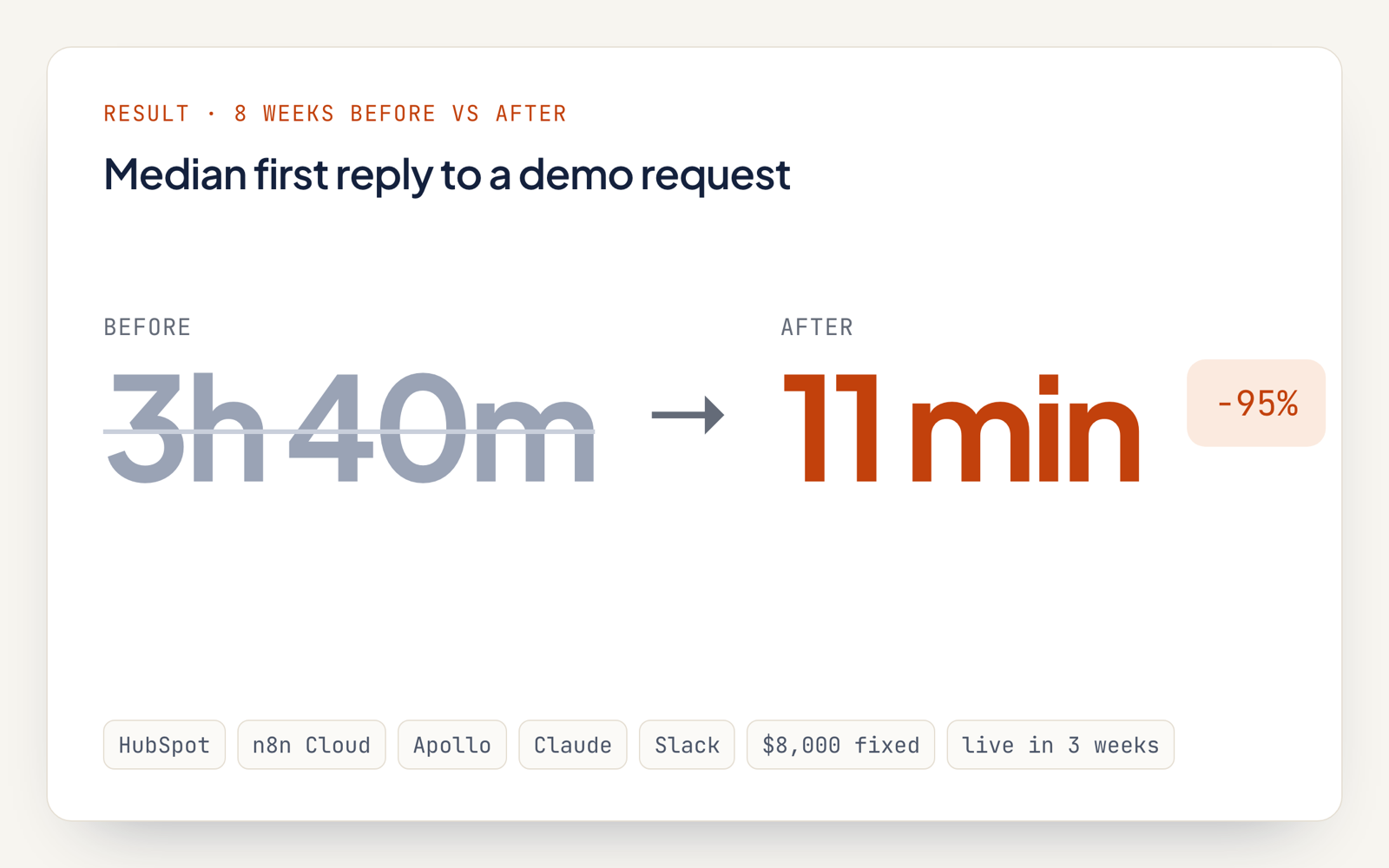
Each case study shows the workflow, the tools and the before-and-after numbers.
FAQ
Is ChatGPT an AI agent?
By default, ChatGPT works as a chat assistant: you send a prompt, it replies. Give it tools and permission to act and it starts behaving like an agent; an agent build wires that up for one specific business task.
What are the 5 types of AI agents?
The standard types are simple reflex, model-based reflex, goal-based, utility-based and learning agents. Most business agents built on large language models fall into the goal-based camp and work through tools.
Do you offer OpenAI consulting?
Yes, we build agents with the OpenAI Agents SDK and Responses API, delivered inside your apps or ChatGPT. We operate as an independent agency with no OpenAI partnership.
What does an AI SDR cost to build?
$12,000 is the starting point for an AI sales agent that researches accounts and drafts outreach for rep approval, live in 4–6 weeks. Model usage is charged to your account.
Can an AI support agent hand off to a human?
Yes, it can. Common questions get answered from your help docs, and any ticket the agent is unsure about passes to a person with a summary attached.
Who owns the agent after the build?
You do. The agent lives in your accounts, and the documentation spells out its prompts, tools and permissions.