
Key takeaways
- Model Context Protocol (MCP) is an open standard from Anthropic that lets AI applications work with outside tools and data.
- A custom MCP server is a compact service owned by you, exposing your systems to AI clients as named tools with set inputs and permissions.
- A custom MCP server works with Claude Desktop, Cursor and ChatGPT alike, and OpenAI advises a Streamable HTTP endpoint for ChatGPT.
- Applied Agents prices each MCP server with a fixed quote following a $1,500 audit, and bundles one into AI agent builds starting at $12,000.
What is a custom MCP server?
A custom MCP server is a small service that links your private data, databases and APIs to AI clients like Claude, ChatGPT or Cursor, exposing only the actions you define.
Those clients talk to it through the Model Context Protocol (MCP), an open standard. Every server has three parts:
- Transport layer:
stdiofor a local desktop process, or HTTP for a remote server. - Tool definitions: named operations with descriptions and input schemas, so the model knows which calls it can make.
- Business logic: the code that converts each tool call into a real action, like a read-only database query.
When do you need a custom MCP server instead of an existing MCP integration?
You need a custom MCP server only when an existing server or connector falls short: the system is internal, the public option grants more access than you want, or your own rules have to apply.
- In-house systems: no public server exists for a homegrown order database or pricing tool.
- Tighter access: the vendor's server permits deletes and bulk edits, while you only want read access plus one write action.
- Your business rules: discounts over a set percentage require a manager's sign-off, or reps see only deals in their own territory.
- Merged data: one tool that answers using the CRM, billing system and contracts at once.
What can a custom MCP server connect AI to?
An MCP server can connect AI to anything with an API or a database, making it the connection layer in every agent we build.
- CRM: pull up an account, review deal history, log a note; deletes stay blocked.
- Documents: search across contracts and policies in a shared drive.
- Databases: run read-only SQL queries for sales or ops reporting.
- Helpdesk: view tickets and queue draft replies for approval.
- Internal APIs: fetch stock, pricing or order status.
Connections like these power our AI agents and Claude agents.
Who needs MCP server development?
MCP development suits B2B companies of 10 to 200 people who want AI assistants working with company data but refuse to hand over full system access.
- Teams on Claude or ChatGPT business plans who expect answers drawn from the CRM and internal tools.
- Businesses running an OpenClaw agent that has to reach business systems through scoped permissions.
- Ops leads required to show an audit trail of everything the AI read or changed.
How much does a custom MCP server cost?
A custom MCP server from Applied Agents has a fixed price, set after a $1,500 audit, and AI agent builds from $12,000 include the MCP connections they need.
| Option | Price | Notes |
|---|---|---|
| Audit and fixed quote | $1,500, 1 week | Lists the tools, actions and permissions |
| MCP server with an agent build | Included, from $12,000 | Live in 4–6 weeks |
| MCP server on its own | Fixed quote from the audit | Priced by number of systems and actions |
| Monthly plan | $2,500/month | Monitoring, fixes and new tools |
| Hourly developers (market) | $100–$300/hour | Typical market range |
See the full price list under pricing.
How do you build an MCP server?
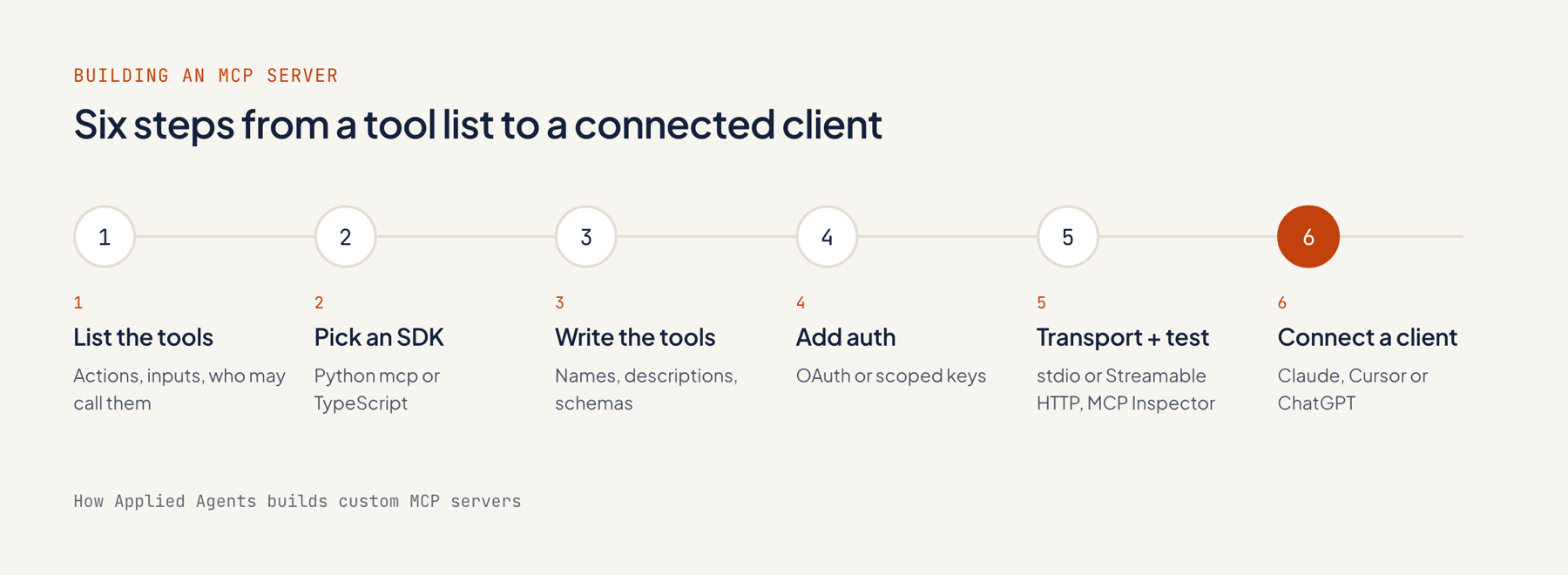
You build an MCP server in six steps, moving from the tool list to the client connection. The official MCP documentation takes care of the code.
- Map the tools: each action, its inputs and who may call it.
- Select an SDK: go with the Python
mcppackage or the TypeScript SDK. - Define the tools: each needs a clear name, description and schema so the model calls it correctly.
- Lock down access: OAuth or scoped API keys only, never an admin login.
- Pick a transport and test it:
stdiolocally, Streamable HTTP at/mcpfor remote work, checked with MCP Inspector as OpenAI recommends. - Hook up the client: register the server in
claude_desktop_config.json, Cursor'smcp.jsonor a ChatGPT connector URL.
These steps sit inside our standard call, audit, build and hand-over; see how it works.
What's included in an MCP server build?
Each build delivers a running server, configured permissions, and documentation to run it.
- The MCP server, deployed to your cloud account.
- Input-validated tool definitions for each agreed action.
- Credentials with narrow scopes, plus an action allow-list.
- Each tool call, logged.
- Client and agent connections you pick, tested on real records.
- A hand-over session backed by written documentation.

Which AI clients can use a custom MCP server?
Several AI clients can connect to one MCP server at the same time, removing the need for a separate integration per client.
| Client | How it connects | Typical use |
|---|---|---|
| Claude Desktop | Local entry in claude_desktop_config.json | Staff asking Claude about company data |
| ChatGPT | Remote server URL over Streamable HTTP | Teams on ChatGPT business plans |
| Cursor | Entry in mcp.json | Developers querying internal APIs |
| Claude Agent SDK or OpenAI Agents SDK | Server registered with the agent | Custom sales, support or document agents |
| OpenClaw | Server added to the self-hosted agent | Chat-based agents on your own server |
How does Applied Agents compare with MCP development companies?
Applied Agents develops MCP servers inside broader business automation engagements for teams of 10–200, while dev shops scope them as software projects, usually for product companies.
| Applied Agents | Freelancer | Dev shop or enterprise firm | DIY with the SDK | |
|---|---|---|---|---|
| Fits | Connecting AI agents to a 10–200 person team's CRM and tools | One small server | MCP for a software product or large estate (Intuz, Boldare) | Teams with a developer and time |
| Price | Fixed quote after a $1,500 audit | $100–$300/hour | Project quotes; enterprise agent work $25,000–$80,000+ | Developer time |
| Comes with | The agent or workflow that uses it | The server only | Server, testing, maintenance retainers | What you build |
What are the security risks of MCP servers?
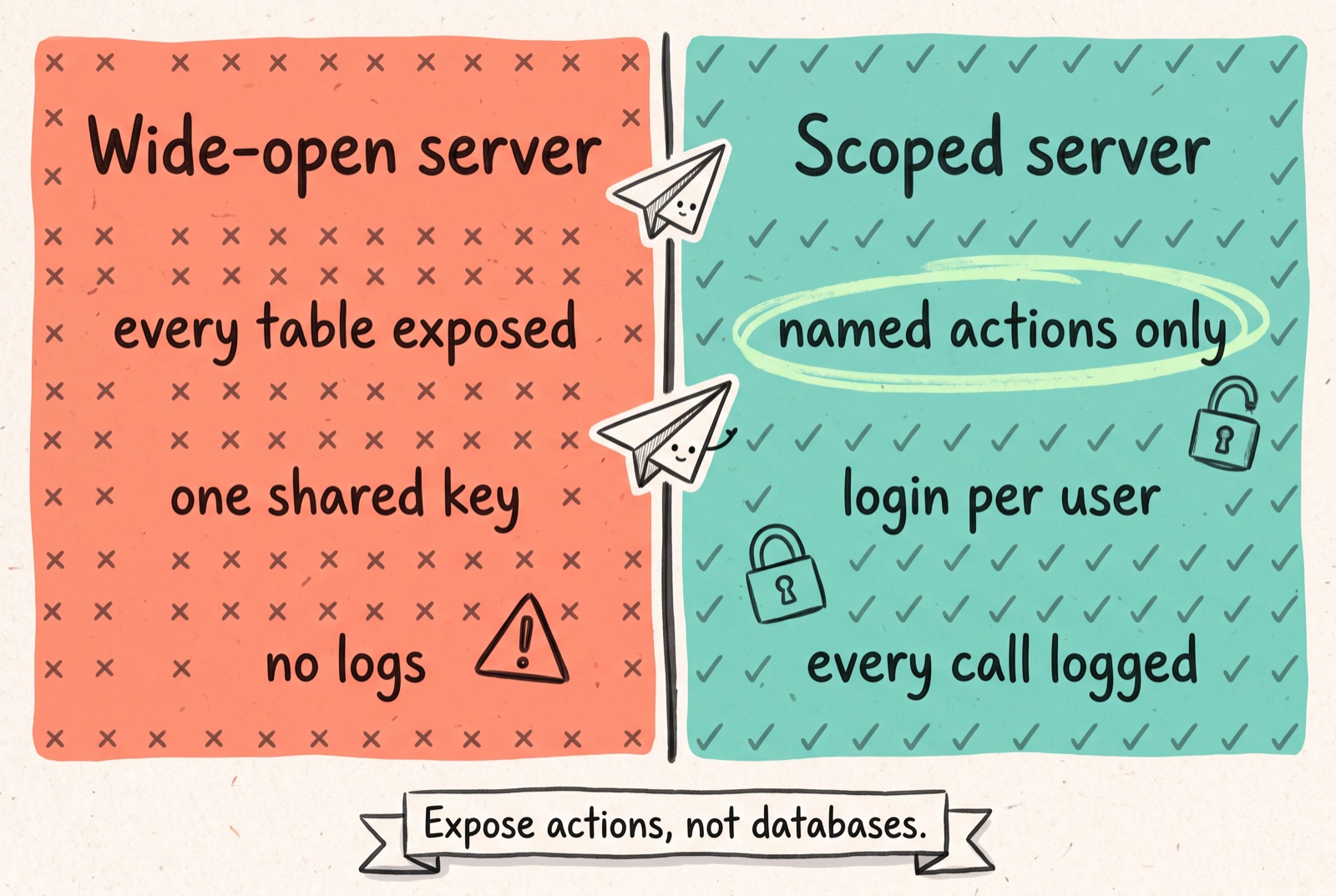
MCP servers carry one core risk: an AI client that goes further than intended. A custom server stays safe by exposing only the actions each task needs.
- Least privilege: read-only by default, with every write action named and approved.
- Human approval for writes: changes that touch customers or money wait for a person.
- Prompt injection: text inside a document or email can try to steer the model, so tools validate inputs and refuse out-of-scope calls.
- Logging and rate limits: every call gets logged, and limits stop runaway loops.
Which projects show this in action?
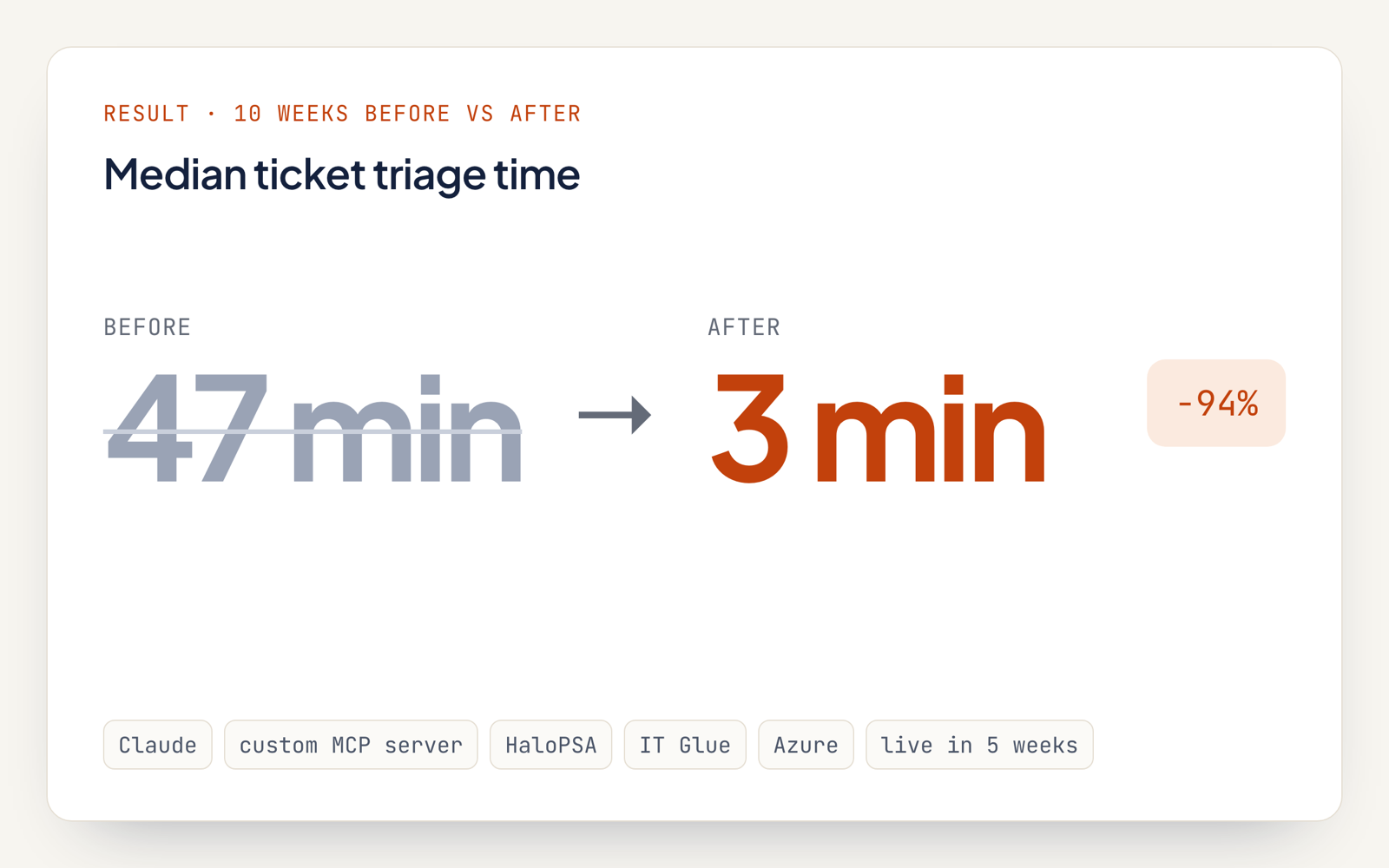
Each case study shows the workflow, the tools and the before-and-after numbers.
FAQ
Who created MCP?
The Model Context Protocol was created by Anthropic, which released it as an open standard. OpenAI's ChatGPT and other clients have since added support too.
Can ChatGPT use a custom MCP server?
Yes. OpenAI's documentation confirms that ChatGPT will discover and call the tools exposed by a custom MCP server connected by URL, and those tools can be anything, not only search and fetch.
Python or TypeScript for an MCP server?
Official SDKs exist for both, so either one works. We decide based on the systems the server has to connect to and the people who will maintain it afterward.
Where does the MCP server run?
Remote clients reach it in your own cloud account, while local desktop setups run it on the user's machine. The code and the host belong to you.
Can one MCP server work with Claude and ChatGPT at the same time?
Yes. One remote server over HTTP can connect to both Claude and ChatGPT, plus your own agents, with the same permissions throughout.
Do you maintain the server after launch?
Yes, on the $2,500 monthly plan. We keep it monitored, respond to issues within 48 hours, and ship new tools every month.